

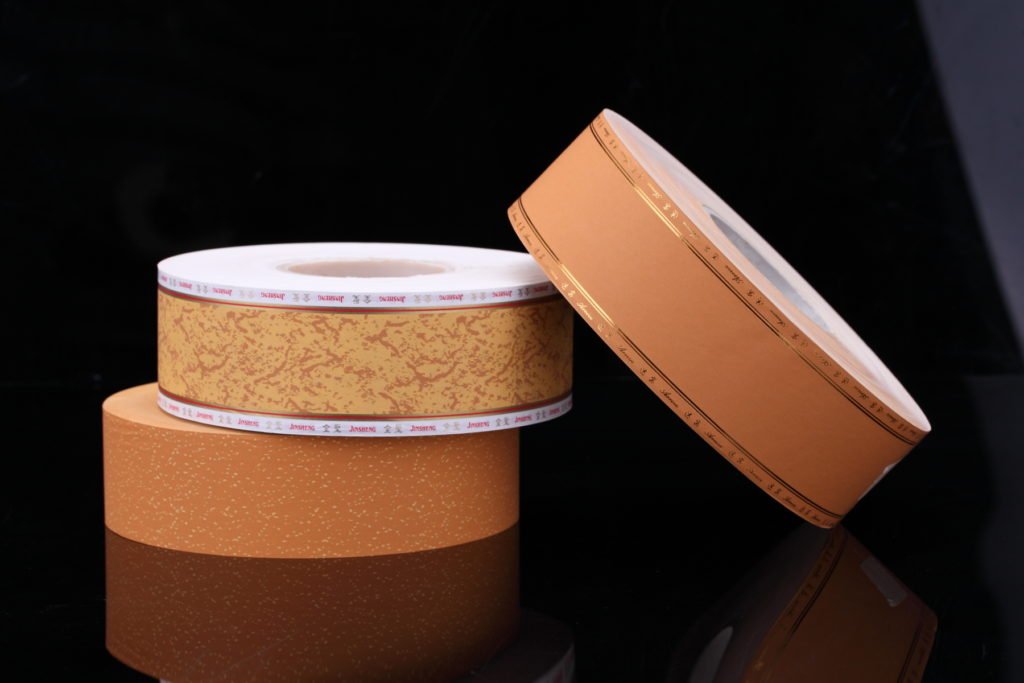
Cigarette Tipping Paper
Tipping paper is the printed wrap around the filter end of a cigarette. It is a non-tobacco material, but it is one of the most visible parts of the product: the brand name, the logo and the colour of the pack all read off this outer layer, so customers judge the cigarette by it.
Printing and finishing
Production has moved a long way from simple one- or two-colour work. Multicolour printing, micro and laser perforation and hotfoil stamping are all run in our factory, and a laser-perforated sheet is chosen for the porosity it gives the filter zone.
Options
- Width and thickness
- Printing pattern and colour
- Standard or flavour-carrying grades, including sweet and flavouring tipping paper
Capacity and ordering
We produce 400 tons of tipping paper each month, which covers both launch volumes and established ranges. Send us the cigarette format, the printing pattern and the specification you need, and we will confirm the grade.
Cigarette tipping paper — typical industry reference
The figures below are typical industry reference values for this product category. They are not measured values for your order. The final specification is set together with your engineers against your cigarette format, your printing and your packing line.
| Base paper | 100% virgin wood pulp, no recycled fibre |
| Base paper grammage | Typically 29–50 g/m², mainstream 34–42 g/m² |
| Air permeability | Typically 60–3000 CU (most perforating equipment is rated 60–2000 CU) |
| Roll width | Typically 35–64 mm, commonly 64 mm |
| Roll length | Typically 2400–3000 m |
| Core inner diameter | Typically 66 / 76 / 120 mm |
| Finished thickness | Typically 34–40 µm |
| Finished moisture | Typically 4.0–5.0% |
| Other typical values | Cobb water absorption 25±5 g/m²; opacity ≥90%; ash 13–16%; tensile strength ≥1.5–1.7 kN/m; elongation ≥1.0–1.8% |
| Types | Printed / foil-stamped (single, double or four-colour) / laser-perforated / functional (flavour-carrying, anti-microbial, security, flame-retardant, transparent window, flocked touch) |
Typical converting route
- Base paper → printing → foil stamping → embossing → slitting → equilibration → laser perforation → static elimination → inspection → packing.
- Printing — multi-colour gravure; the print is normally built in layers (base ink, colour ink, top ink) plus a varnish coat so the colour does not sink and fade.
- Laser perforation — the reference values for the perforated types are an aperture of 0.08–0.12 mm, a hole pitch of 0.8–1.2 mm, two rows and a row spacing of 1.9–2.3 mm. Aperture, pitch and row spacing are what set the air permeability.
What decides whether it runs
- Air permeability and its variation — for the perforated types this is the core controlled property, because it is what dilutes the smoke.
- Contact with the lips — inks and coatings must meet food-contact requirements.
- Wet strength — the paper has to resist saliva without softening, shedding fibres or losing colour.
- Dimensional stability — the sheet must not distort with changes in temperature and humidity, or the cigarette cannot be formed cleanly.
- Solvent residue — the reference test method is headspace gas chromatography–mass spectrometry (HS-GC/MS).
Standards and compliance
The category's former national standard was withdrawn in 2025 and no direct replacement has been issued, so this product is made to our internal control standard together with the base-paper specification and the applicable food-contact regulations. Food-contact declarations and a solvent-residue (HS-GC/MS) test report are provided on request.
Request a tipping paper quotation
Tell us the cigarette format, the grammage and the permeability you need. Our engineers reply with a specification and a quotation — usually within 24 hours.
Pricing available on inquiry — MOQ varies.